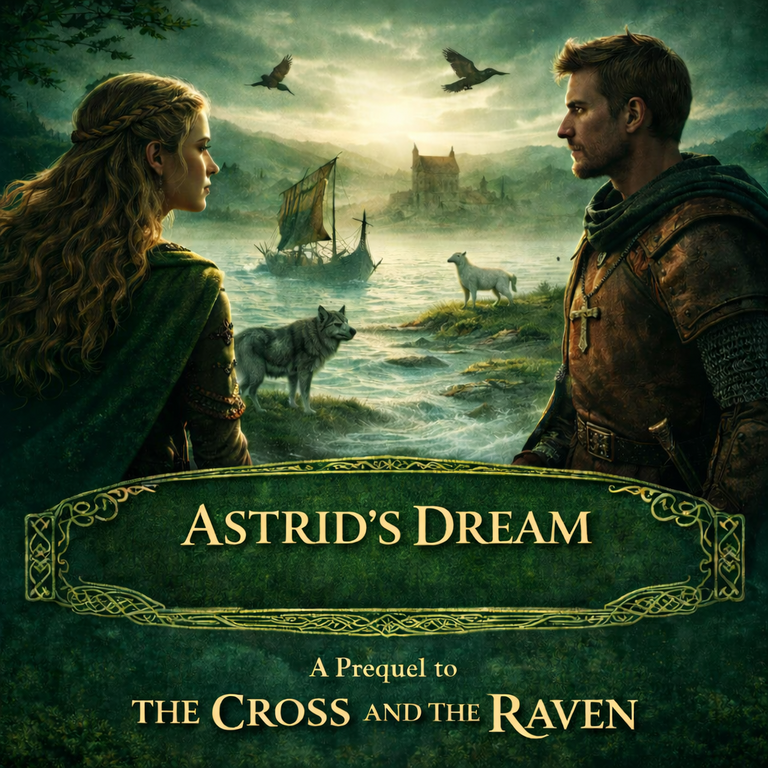
Astrid’s Dream
A Prequel to The Cross and the Raven
by Jessica Thomas
The first time Astrid dreamed of him, there was no clash of steel, no cries of battle, and no blood darkening foreign sand. There was only wind moving steadily down from the fjord, threading through pine and timber and carrying with it the salt-heavy breath of the sea. She stood alone at the cliff’s edge above her village, the evening sky dissolving from gray into indigo, the last light caught along the dark swells below. The ravens had gathered early that night, lining the carved prow of the longship pulled onto shore and settling along the ridge stones in uncanny stillness, their silence more unsettling than any cry. Behind her, the village prepared for winter’s final feast—laughter spilling from the mead hall, axes striking wood in measured rhythm, smoke rising warm and fragrant into the cold air—yet beneath the familiar sounds lay something strained and waiting, a tension she could feel not in her ears but in her bones.
When her mother called her name from the stone circle at the center of the settlement, Astrid turned as she always did, obedient but alert. Svala already stood beside the altar stone, amber and bone beads resting against her throat, silver threaded through her dark braid, her presence as steady as carved granite. The villagers quieted as Astrid stepped forward and knelt beside her. She had breathed juniper smoke before; she had listened for the patterns that revealed themselves when the world loosened its grip. Yet that evening the air felt heavier, the smoke thicker as it coiled upward in slow spirals. Astrid closed her eyes and let her thoughts soften, neither reaching nor resisting, and the wind along the fjord dissolved into something unfamiliar.
The sea vanished. The mountains fell away. The ground beneath her shifted from stone and frost to damp earth and flattened grass beneath a copper-streaked sky she had never known. She stood in open fields stretching toward a low tree line, smoke drifting not from ritual fire but from something burned in haste. And there—at the center of that altered world—stood a man she had never seen and yet somehow recognized. He wore iron and leather marked by use rather than pride, his shoulders squared not in arrogance but in endurance, a thin line of dried blood tracing his temple as though he had only just stepped from conflict. Around his neck hung a simple wooden cross.
Behind him, the air felt divided. To one side loomed a wolf, massive and golden-eyed, silent but coiled with power. To the other stood a lamb, white and trembling, yet strangely unafraid. The man did not move toward either. He did not retreat. He simply stood between them, grounded and unyielding. And then, as though sensing her presence beyond smoke and distance, he lifted his gaze.
He looked directly at her.
Though she knew she stood unseen within vision, she felt awareness strike her like cold water. It was not confusion in his eyes, nor fear, but recognition—as though some unseen thread had tightened between them. The warmth of that strange sky rushed away, replaced by the biting wind of Norway, and she gasped as her eyes flew open to the circle of villagers and the smell of juniper still lingering in her lungs.
“What did you see?” her mother asked, her voice composed yet sharpened by quiet urgency.
“A man,” Astrid whispered, aware of how many strained to hear. “He wore the sign of the White Christ.”
A murmur rippled through the gathered villagers.
“And?” Svala prompted.
“He stood between wolf and lamb,” Astrid said, her gaze drifting westward beyond the fjord. “He did not choose.”
The ravens cried out then, their sudden harsh voices breaking the hush, and Torvald stepped forward with narrowed eyes. “Is it warning?” he asked.
Astrid felt the sea pulling at her thoughts like a tide. “It is crossing,” she replied.
That night she did not sleep. The image clung to her as salt clings to skin—the weight of his stance, the steadiness in his gaze, the cross resting against his chest. Somewhere beyond the vast dark stretch of water, beneath a sky not her own, he breathed real air. The thread she had felt in vision did not dissolve with waking. It tightened.
Across that same sea, miles beyond her imagining, Eadric stood outside the small stone church at the edge of Mercia, listening to its uneven bells ring against a restless wind. The harvest had been thin, the king distracted by threats from rival kingdoms, and whispers of northern sails had begun to move along the old Roman roads once more. He did not fear easily; his life had been shaped by duty and discipline, by sword practice and quiet prayer. Yet that evening, as the wind shifted, he felt something pause the world between heartbeats. He closed his eyes—not fully in prayer, not fully in surrender—and for the briefest instant he saw smoke curling upward, not incense but something wilder, tinged with salt and pine. Within it stood a woman with dark hair caught in wind, her gaze steady and unflinching. She did not beckon. She did not speak. She simply stood.
The vision vanished as quickly as it came, leaving him unsettled in a way he could not name. He did not believe in such things, not in omens drawn from drifting smoke, yet his hand had risen unconsciously to the wooden cross at his throat, as though grounding himself in something known might steady what was not.
Three days later, Norse ships were sighted off the coast of Mercia.
Three days later, Astrid stood at the prow of a longship, the sail swelling with wind as the fjord gave way to open sea and the horizon widened into promise and threat alike.
Three days later, Eadric rode toward a coastal ridge where dragon-prowed vessels cut across gray water with deliberate purpose.
Neither knew the other’s name. Neither understood the cost that would follow. The wolf had begun to move, the lamb had not fled, and the man between them still stood.
Their story does not begin with love. It begins with vision, with invasion, with a choice that will test faith more sharply than steel ever could. If you wish to know what happens when mercy interrupts death, when old gods and new collide upon foreign sand, and when two enemies discover that standing between forces may be the most dangerous position of all, then the crossing has only just begun.
Continue the journey in The Cross and the Raven: A Viking Era Romance. The sea is waiting.
Books for Further Reading