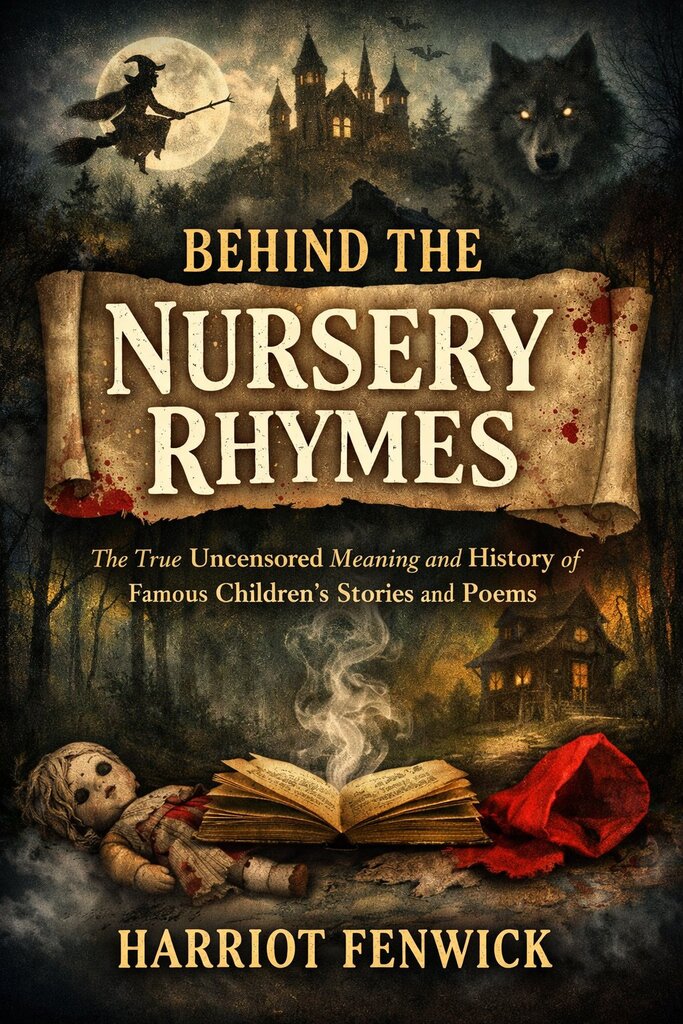
by Harriot Fenwick
What if the stories you learned as a child were never meant to be innocent?
For centuries, nursery rhymes and fairy tales have been softened, simplified, and sanitized—marketed as gentle entertainment for young minds. But beneath their cheerful rhythms and familiar characters lies a far older purpose: to warn, instruct, and prepare children for a dangerous world.
In Behind the Nursery Rhymes, cultural historian Harriot Fenwick peels back centuries of revision and nostalgia to reveal the true origins, historical contexts, and unsettling meanings behind the world’s most famous children’s stories.
This is not speculation masquerading as fact. It is a carefully researched exploration of oral tradition, folklore, censorship, and cultural memory, grounded in historical evidence and scholarly restraint.
What This Book Reveals
- Why early children’s stories were never intended to comfort
- How fear, death, punishment, and loss were used as tools of survival and moral instruction
- Which nursery rhymes may reflect real political, religious, or social conflict—and which popular myths don’t hold up under scrutiny
- How oral storytelling encoded history when open speech was dangerous
- Why modern adaptations radically transformed these stories—and what was lost in the process
Inside You’ll Explore
Part I — Foundations of Children’s Literature
How childhood itself was once understood, and why early stories embraced danger instead of protection.
Part II — Famous Nursery Rhymes: Origins & Meanings
A careful, evidence-based examination of the most debated rhymes—separating folklore from modern mythmaking.
Part III — Fairy Tales Before They Were Softened
The darker, original versions of familiar tales—and why their brutality made sense in historical context.
Part IV — Authored Fairy Tales & Literary Shifts
How writers like Andersen and Carroll reshaped children’s literature through personal pain, symbolism, and emerging ideas of childhood.
Part V — Collectors, Authors, and Cultural Gatekeepers
The role of the Brothers Grimm, Charles Perrault, Mother Goose, and others in preserving—and altering—oral tradition.
Part VI — Global & Cross-Cultural Stories
Dark folktales from around the world, including Indigenous and East Asian traditions.
Part VII — Modernization, Censorship, and Legacy
How Victorian morality, Disney, and modern sensitivity reshaped these stories—and why they still matter today.
Who This Book Is For
 Readers fascinated by folklore, mythology, and cultural history Parents and educators seeking truthful, age-appropriate context Writers, scholars, and students of literature and oral tradition Anyone who has ever suspected that children’s stories were never as simple as they seemed
A Note on Interpretation
Where historical certainty exists, it is clearly documented. Where meaning is debated, interpretations are explicitly identified as theoretical, respecting the complexity of oral tradition and avoiding sensationalism.
This book does not claim to expose “secret meanings”—it restores historical honesty.
Why These Stories Still Matter
Children’s stories endured because they worked.
They taught caution when mistakes were fatal.
They preserved memory when writing was rare.
They told the truth when truth could not be spoken aloud.
Behind the Nursery Rhymes invites you to listen again—with clarity instead of nostalgia, and understanding instead of myth.