What the Story Really Means
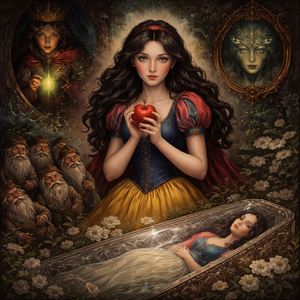
When most people think of Snow White, they picture a gentle fairy tale filled with singing birds, friendly dwarfs, and a happily-ever-after ending. But the original version of Snow White, as recorded in European folklore and later written down by Brothers Grimm, is far darker, more psychological, and deeply symbolic.
This story was never meant to be a light children’s bedtime tale. It was a moral warning, a rite-of-passage allegory, and a reflection of medieval fears about beauty, envy, death, and womanhood.
The Original Snow White Story (Not the Sanitized Version)
In the earliest Grimm versions, Snow White is born to a queen who dies shortly after her birth. Her father remarries a woman obsessed with beauty and status. Each day, the queen asks her enchanted mirror:
“Mirror, mirror on the wall, who is the fairest of them all?”
When the mirror declares Snow White more beautiful, the queen’s envy turns murderous.
The First Murder Attempt
The queen orders a huntsman to take Snow White into the forest and kill her, demanding her lungs and liver as proof. The huntsman cannot bring himself to do it and instead kills a wild animal. The queen cooks and eats the organs, believing she is consuming Snow White herself.
This detail—later removed—symbolizes ritualistic power transfer and the belief that consuming another grants dominance or vitality.
Life with the Dwarfs
Snow White finds refuge with seven dwarfs, who are not comic figures but miners and laborers, representing discipline, routine, and survival. They warn her repeatedly not to let anyone into the house.
She disobeys three times.
Three Poisonings
The queen disguises herself and attempts to kill Snow White repeatedly:
-
A lace bodice tightened until Snow White collapses
-
A poisoned comb placed in her hair
-
The poisoned apple, half harmless, half lethal
The apple finally succeeds, symbolizing forbidden knowledge and temptation, echoing older biblical and mythological traditions.
Snow White does not awaken from love’s kiss in the original tale. A servant stumbles while carrying her coffin, dislodging the apple from her throat.
The Queen’s Punishment
At Snow White’s wedding, the queen is forced to wear red-hot iron shoes and dance until she dies.
Justice, in this world, is brutal and absolute.
What Snow White Was Really About
1. Envy and Narcissism
The Evil Queen is not merely “evil”—she represents pathological narcissism, unable to accept aging or being surpassed. Her obsession with the mirror reflects how identity collapses when self-worth is based solely on appearance.
The mirror does not lie—but it also does not comfort.
2. Death as Transformation
Snow White’s repeated “deaths” are symbolic. She moves from childlike innocence toward adulthood through danger, suffering, and rebirth. The glass coffin represents suspended transition—a liminal state between girlhood and maturity.
This was a familiar concept in pre-modern storytelling, where death often stood in for psychological or social change.
3. Female Rivalry in Patriarchal Systems
In many early versions, the queen is Snow White’s biological mother, not stepmother. This reflects deep-rooted cultural anxieties about youth replacing age, fertility fading, and women being valued primarily for beauty.
The rivalry is not personal—it is structural.
4. Disobedience and Consequence
Snow White is repeatedly warned. She repeatedly disobeys. Unlike modern adaptations that soften this, the original tale stresses personal responsibility. Innocence alone does not protect you; wisdom does.
Why the Story Was Later Softened
As fairy tales shifted from oral tradition to children’s literature, especially in the 19th and 20th centuries, violence and sexual symbolism were removed. Disney’s Snow White and the Seven Dwarfs reframed the story into a moral of kindness and romance, replacing:
-
Cannibalism with comedy
-
Sexual rivalry with cartoon villainy
-
Justice with mercy
This made the story accessible—but less truthful to its origins.
Why the Original Snow White Still Matters
The original Snow White endures because it speaks to timeless truths:
-
Beauty fades, and envy follows
-
Innocence must grow into awareness
-
Evil often disguises itself as care
-
Justice is not always gentle—but it is final
These stories survived for centuries because they told the truth people were afraid to say out loud.
They were not meant to comfort children.
They were meant to prepare them.
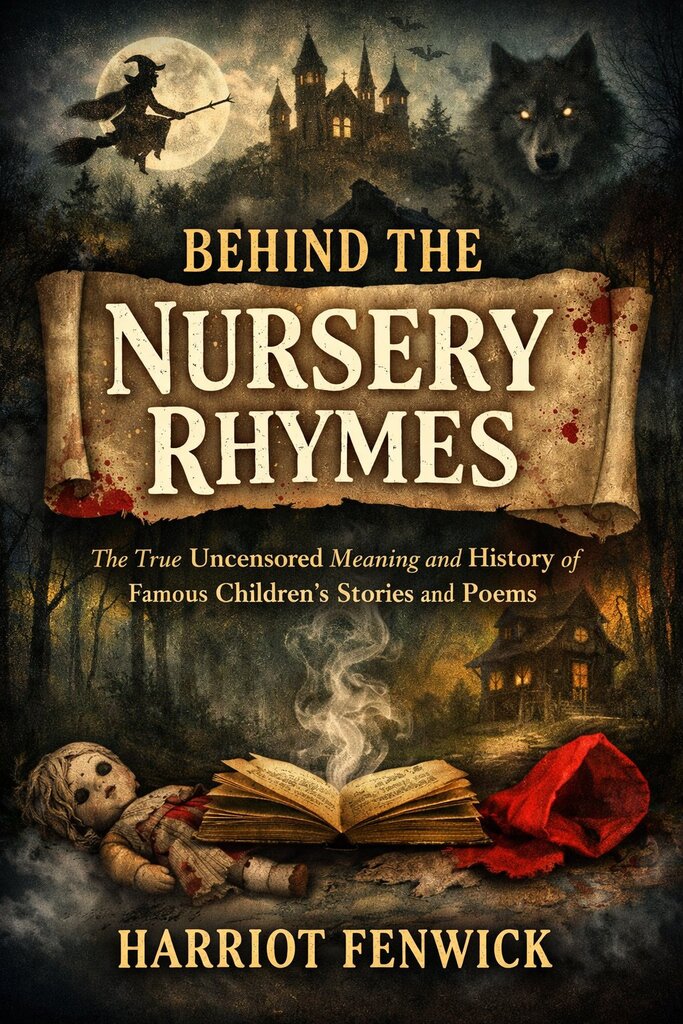
For more details on this and other fairy tales, check out the book Behind the Nursery Rhymes by Harriot Fenwick.
Books for Further Reading